Showing posts with label Dante Gabriel Rossetti. Show all posts

2025/11/16

aspecta medusa:

This was our favorite at the Passion and Pathos exhibit.


Bronze medallion of Athena Promachos, wearing a helmet in
the form of Medusa's head and the aegis over her left shoulder.
A decoration from a formal chariot used for parades. Possibly
from a workshop in Delos, 2nd century BC.
Thessaloniki Archaeological Museum.

More about this figure below


Andromeda, by Perseus sav'd and wed,
Hanker'd each day to see the Gorgon's head:
Till o'er a fount he held it, bade her lean,
And mirror'd in the wave was safely seen
That death she liv'd by.
Let not thine eyes know
Any forbidden thing itself, although
It once should save as well as kill: but be
Its shadow upon life enough for thee.~DGRossetti's poem.


Which means, in the neo-platonic-speak of depth psychology:
The Medusa, one of three sisters originally, beautiful, a priestess in the Temple of Athena; that is, a beautiful mortal in the sacred sphere (a temple being the eye of the polis) of Wisdom. And Beauty is the direct apprehension of the Good, the pure Being of the stillpoint (the exact center of a sphere, which is unmoved even as the whole turns); an aspect, or rather a reflection of the perfect, the divine, the One: Things that can "exist" only outside of time. Things Eternal, timeless as in without time -- and thus, dangerous to look at directly... Not something that can belong to the (time-bound) mortal. So of course the earth shaker comes to shake things up: Poseidon, a god who goes back before Homer. And he rapes the priestess right there in the temple. And the goddess of Wisdom punishes her for it. Was it her fault, being a carrier of things outside of time? She, a virgin priestess, servant of that wisdom? No, not her fault any more than it is ours to be vessels of consciousness who apprehend the immortal, a thing we cannot have (which in platonic-speak summons eros: desire, mover of "the sun and all the stars"). Medusa suffers the loss of her beauty as we must suffer death. She becomes a creature no mortal can look upon -- the mysteries as they truly are: eternal, belonging outside of time. To violate this is to be an abomination (calling down destruction, see similar fate in Actaeon Surprising Diana), and that is her face with the snakes for hair, snakes that crawl in and out of darkness, writhing and unnatural in the world of time and space, one end in the light and the other in the dark unconscious. Yet -- snakes also are healers, sacred to Asclepius.

She, Medusa, a symbol, terror itself, and creature of our most profound pity. She, our own self, each of us, forced to live with the knowledge that we will suffer death. And so Perseus comes as a resolution. Again, he is each of us, taught and armed by the psychopomp Hermes, slicing off Medusa's head (think chakras) without directly looking at her (fearless!), precipitating the higher birth of Pegasus -- imagination. Pegasus who soars, tended by muses, pawing the earth and setting the deep springs to flow: art itself. Pegasus, winged horse, beloved, an eros who moved it all from the beginning
 https://www.artrenewal.org/pages/artwork.php?artworkid=41471


reaching back beyond all this, see http://www.perseus.tufts.edu/classes/finALp.html ,  http://ccat.sas.upenn.edu/bmcr/2007/2007-04-61.html


And -- what a gift -- find Joan Marler's wonderful in- depth academic discussion here:


The figure of the Gorgon Medusa, slain by the Greek hero Perseus, has lived in the Western imagination for more than 2500 years. Who is she, and how and when did she appear, and why was she decapitated? This complex image that spread throughout the
ACADEMIA.EDU

See also Chrysaor, Geryon, Edinger, Eros


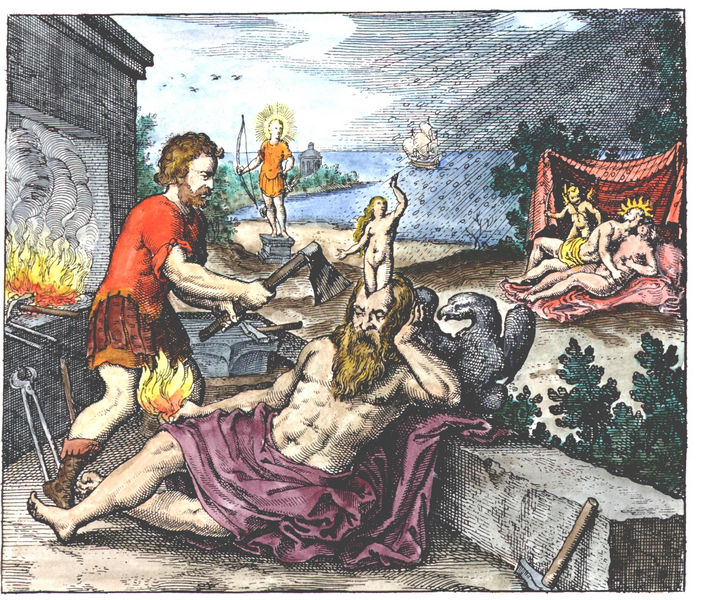
 For Pallas is Sophia or Wisdom, who carries health in her right hand and riches in her left, providing at the same time both for man's ease and plenty. To Her Perseus brought the head of Medusa which turned all thinges into Stone, and was horrid in its appearance with serpents and vipers instead of Hairs; which she afterwards placed in her shield to use it against her Enemyes, that is to say Rude and Barbarous people who are therefore to be turned into Stones. And in truth Wisdom or Naturall Philosophye renders its incredulous and envious condemners quite stupid and void of sense and understanding by the means of that same thinge, from whence Chrysaor was borne who was the father of Geryon who had three bodyes. That is by the means of the Lapiditick Gorgonian blood, which is nothing else but the Tincture of the Philosophick Stone. ~ Atalantafugiens, emblem 23

2016/02/25

The Ascent / Eros Psychopompos


For one who looks at Beauty in the only way that Beauty can 
be seen—only then will it become possible for him to give birth 
(tiktein) not to images of virtue—because he’s in touch with no 
images—but to true virtue—because he is in touch with true 
Beauty. And being theophiles (god-loved/god-loving) belongs 
to anyone who has given birth to true virtue and nourished it, 
and if any human being could become immortal, it would be 
this one.  ~Diotima in The Symposium


Evans, Nancy in Hypatia, Volume 21, Number 2, Spring 2006, pp. 1-27


2015/04/20

aspecta medusa:

This was our favorite at the Passion and Pathos exhibit.


Bronze medallion of Athena Promachos, wearing a helmet in
the form of Medusa's head and the aegis over her left shoulder.
A decoration from a formal chariot used for parades. Possibly
from a workshop in Delos, 2nd century BC.
Thessaloniki Archaeological Museum.

More about this figure below


2012/09/12

Beloved

Rossetti: mystical icon  "Fire within fire, desire in deity." (see his poem The Kiss)

Ah, did you miss that symbol? You won't from now on. :)

When Rossetti speaks of Beauty, he's speaking of the Forms... from a more neo-platonic, Dantean, Sufic cant (love that word); the Hermetic as above, so below, as in his Blessed Damozel. And then there's his father's Speculative Freemasonry. (note)

Blake (whom Rossetti championed and helped see to print):

1. Man has no Body distinct from his Soul for that call'd Body is a portion of Soul discern'd by the five Senses, the chief inlets of Soul in this age

2. Energy is the only life and is from the Body and Reason is the bound or outward circumference of Energy.

3 Energy is Eternal Delight

note:
link Dante Gabriel Rossetti (1828-1882). Artist and poet and a member of the Pre-Raphaelite Brotherhood. Rossetti was instrumental in the revival of interest in the work of William Blake in the 1860s and, with his brother William Michael Rossetti, he helped Anne Gilchrist to finish her husband Alexander’s Life of Blake after his death. He would have learned of Swedenborg through his interest in Blake, but the most important Swedenborgian influence on his own work, seen particularly in The Blessed Damozel (both a painting and a poem), came from Conjugial Love through his friend Robert Browning*, whose poetry he greatly admired. Rossetti was also a friend of Garth Wilkinson, who attended his wife the artist Lizzie Siddal on one occasion.
References: The Age of Rossetti,Burne-Jones and Watts: Symbolism in Britain 1860-1910(exhibition catalogue, Tate Gallery Publishing, 1997), article by Robert Upstone at pages 191-3, and Clement James Wilkinson, James John Garth Wilkinson (1911).
(Actually, it wasn't Robert Browning who was into Swedenborg, so much as his wife Elizabeth Barrett Browning, the wogga-wogga one of the pair.)

Anyway -- The Bride / Beloved is part of the London exhibit:

London show explores Pre-Raphaelite radicals

Beloved

Rossetti: mystical icon  "Fire within fire, desire in deity." (see his poem The Kiss)

Ah, did you miss that symbol? You won't from now on. :)

When Rossetti speaks of Beauty, he's speaking of the Forms... from a more neo-platonic, Dantean, Sufic cant (love that word); the Hermetic as above, so below, as in his Blessed Damozel. And then there's his father's Speculative Freemasonry. (note)

Blake (whom Rossetti championed and helped see to print):

1. Man has no Body distinct from his Soul for that call'd Body is a portion of Soul discern'd by the five Senses, the chief inlets of Soul in this age

2. Energy is the only life and is from the Body and Reason is the bound or outward circumference of Energy.

3 Energy is Eternal Delight

note:
link Dante Gabriel Rossetti (1828-1882). Artist and poet and a member of the Pre-Raphaelite Brotherhood. Rossetti was instrumental in the revival of interest in the work of William Blake in the 1860s and, with his brother William Michael Rossetti, he helped Anne Gilchrist to finish her husband Alexander’s Life of Blake after his death. He would have learned of Swedenborg through his interest in Blake, but the most important Swedenborgian influence on his own work, seen particularly in The Blessed Damozel (both a painting and a poem), came from Conjugial Love through his friend Robert Browning*, whose poetry he greatly admired. Rossetti was also a friend of Garth Wilkinson, who attended his wife the artist Lizzie Siddal on one occasion.
References: The Age of Rossetti,Burne-Jones and Watts: Symbolism in Britain 1860-1910(exhibition catalogue, Tate Gallery Publishing, 1997), article by Robert Upstone at pages 191-3, and Clement James Wilkinson, James John Garth Wilkinson (1911).
(Actually, it wasn't Robert Browning who was into Swedenborg, so much as his wife Elizabeth Barrett Browning, the wogga-wogga one of the pair.)

Anyway -- The Bride / Beloved is part of the London exhibit:

London show explores Pre-Raphaelite radicals

2011/11/01

Desire Is Holy

New book out about Dante Gabriel Rossetti.

Review here.

Publisher's blurb, via Amazon:

Dante Gabriel Rossetti is the most intriguing and flamboyant figure in nineteenth-century British art. He inspired the first Pre-Raphaelite generation of 1849 and the second generation ten years later and both brought about significant changes in British art. His poetry, too, acted as a stimulus to many writers at the end of the century, who saw in his subtle manipulation of the sonnet and the ballad forms ways of giving expression to issues that were peculiar to the that century.
Dominant among those issues was that of sexual desire, for Rossetti, more than any other artist in this period, struggled with the contradictions of sexuality. When he died in 1882 people knew of him as the painter of alluring women with exotic names - Lilith, Monna Vanna, Fiammetta - and the writer of subtly erotic verse. He projected onto women his anxieties, his pleasures and his needs. He also mythologized them, so that Elizabeth Siddal, Fanny Cornforth, Jane Morris and others became for him Beatrice, Guenevere, and Isolde. In doing so he shaped them, he changed the direction of their lives, and in some cases he both made and destroyed them.
This richly illustrated book, by tracing the development of Rossetti's painting and poetry in the context of the drama of his life, follows this powerful thread. Sometimes sensual, at others spiritual, Rossetti's mission was to transcend the Manichean division that separated body and soul and, through the visionary power of art, reconcile what he saw as elements fundamental to human experience.


"Dominant among those issues was that of sexual desire, for Rossetti, more than any other artist in this period, struggled with the contradictions of sexuality." Have to read the book. But I do know Mr. Rossetti rather well--and for him, sexual desire doesn't begin to contain him. When he says Hand painted the Soul, he's speaking of serving big L libido -- life force itself, Beauty as harbinger, emanation of the Good. Religion of Art? Sure. And I tend to fancy him (a whole book's worth, to what green altar) as Corbin-style Sufi by way of an occult Dante, magician philosopher in the old style roots of Western tradition -- saying in Heart's Hope

For lo ! in some poor rhythmic period, Lady, I fain would tell how evermore Thy soul I know not from thy body, nor Thee from myself, neither our love from God.

And then there's Ken Russell's take.

That odd, punishing nature. Rossetti had no understanding of it.

As far as longing can reach.  -- reminding us that longing is thumos, the energy of life itself.
Betwixt the sun and moon a mystery

Desire Is Holy

New book out about Dante Gabriel Rossetti.

Review here.

Publisher's blurb, via Amazon:

Dante Gabriel Rossetti is the most intriguing and flamboyant figure in nineteenth-century British art. He inspired the first Pre-Raphaelite generation of 1849 and the second generation ten years later and both brought about significant changes in British art. His poetry, too, acted as a stimulus to many writers at the end of the century, who saw in his subtle manipulation of the sonnet and the ballad forms ways of giving expression to issues that were peculiar to the that century.
Dominant among those issues was that of sexual desire, for Rossetti, more than any other artist in this period, struggled with the contradictions of sexuality. When he died in 1882 people knew of him as the painter of alluring women with exotic names - Lilith, Monna Vanna, Fiammetta - and the writer of subtly erotic verse. He projected onto women his anxieties, his pleasures and his needs. He also mythologized them, so that Elizabeth Siddal, Fanny Cornforth, Jane Morris and others became for him Beatrice, Guenevere, and Isolde. In doing so he shaped them, he changed the direction of their lives, and in some cases he both made and destroyed them.
This richly illustrated book, by tracing the development of Rossetti's painting and poetry in the context of the drama of his life, follows this powerful thread. Sometimes sensual, at others spiritual, Rossetti's mission was to transcend the Manichean division that separated body and soul and, through the visionary power of art, reconcile what he saw as elements fundamental to human experience.


"Dominant among those issues was that of sexual desire, for Rossetti, more than any other artist in this period, struggled with the contradictions of sexuality." Have to read the book. But I do know Mr. Rossetti rather well--and for him, sexual desire doesn't begin to contain him. When he says Hand painted the Soul, he's speaking of serving big L libido -- life force itself, Beauty as harbinger, emanation of the Good. Religion of Art? Sure. And I tend to fancy him (a whole book's worth, to what green altar) Corbin-style by way of an occult Dante, magician philosopher in the old style roots of Western tradition -- saying in Heart's Hope

For lo ! in some poor rhythmic period, Lady, I fain would tell how evermore Thy soul I know not from thy body, nor Thee from myself, neither our love from God.

And then there's Ken Russell's take.

That odd, punishing nature. Rossetti had no understanding of it.

As far as longing can reach.  -- reminding us that longing is thumos, the energy of life itself.
Betwixt the sun and moon a mystery

2011/08/06

the Beautiful is difficult

Nice understanding of changing artistic philosophy and the PRB's truth to nature.
Primitive brotherhood of Renaissance masters


the Beautiful is difficult

Nice understanding of changing artistic philosophy and the PRB's truth to nature.
Primitive brotherhood of Renaissance masters


2011/04/12

Corbin - Dante - i Fedeli d'Amore

This is so Rossetti*, who, like a priest, uses his art to consecrate the material.
link

*Heart’s Hope

Dante Gabriel Rossetti (1828–1882)

BY what word’s power, the key of paths untrod,
Shall I the difficult deeps of Love explore,
Till parted waves of Song yield up the shore
Even as that sea which Israel crossed dryshod?
For lo! in some poor rhythmic period,
Lady, I fain would tell how evermore
Thy soul I know not from thy body, nor
Thee from myself, neither our love from God.

Yea, in God’s name, and Love’s, and thine, would I
Draw from one loving heart such evidence
As to all hearts all things shall signify;
Tender as dawn’s first hill-fire, and intense
As instantaneous penetrating sense,
In Spring’s birth-hour, of other Springs gone by.

___________________

From The Prophetic Meaning of Beauty. Henry Corbin on Ruzbehan Baqli of Shiraz:
There is, out of all human experiences, one unique event that leads to this union: human love for a being of beauty. Such a love is purified of all carnal, possessive instincts, all utilitarian ends, all obsessions and neurotic “needs.” Such a chaste love is an ecstasy before the revelation of divine beauty in a being of beauty, a theophany. This cult of Beauty was professed by Ibn ‘Arabi, and in Iran by Ruzbehan Baqli of Shiraz and all of his school. These Corbin calls the Fidèles d’amour in order to highlight their affinities with the Fedeli d’amore of Dante.
[...]
Beauty understood in this way is experienced as a sacred sign, a sacrament. At the limit of this experience of love, a love that “does not split,” is the esoteric experience of tawhîd: The Divine being is simultaneously the Loved, the Lover and the Love itself. (p. 17)

~~~~~~~~~~~~~~~
background music:

Corbin - Dante - i Fedeli d'Amore

This is so Rossetti*, who, like a priest, uses his art to consecrate the material.
link

*Heart’s Hope

Dante Gabriel Rossetti (1828–1882)

BY what word’s power, the key of paths untrod,
Shall I the difficult deeps of Love explore,
Till parted waves of Song yield up the shore
Even as that sea which Israel crossed dryshod?
For lo! in some poor rhythmic period,
Lady, I fain would tell how evermore
Thy soul I know not from thy body, nor
Thee from myself, neither our love from God.

Yea, in God’s name, and Love’s, and thine, would I
Draw from one loving heart such evidence
As to all hearts all things shall signify;
Tender as dawn’s first hill-fire, and intense
As instantaneous penetrating sense,
In Spring’s birth-hour, of other Springs gone by.

___________________

From The Prophetic Meaning of Beauty. Henry Corbin on Ruzbehan Baqli of Shiraz:
There is, out of all human experiences, one unique event that leads to this union: human love for a being of beauty. Such a love is purified of all carnal, possessive instincts, all utilitarian ends, all obsessions and neurotic “needs.” Such a chaste love is an ecstasy before the revelation of divine beauty in a being of beauty, a theophany. This cult of Beauty was professed by Ibn ‘Arabi, and in Iran by Ruzbehan Baqli of Shiraz and all of his school. These Corbin calls the Fidèles d’amour in order to highlight their affinities with the Fedeli d’amore of Dante.
[...]
Beauty understood in this way is experienced as a sacred sign, a sacrament. At the limit of this experience of love, a love that “does not split,” is the esoteric experience of tawhîd: The Divine being is simultaneously the Loved, the Lover and the Love itself. (p. 17)

~~~~~~~~~~~~~~~
background music: