Showing posts sorted by relevance for query alchemy. Sort by date Show all posts

2012/09/17

cant redux and how it started, redux


cant n.

  1. Angular deviation from a vertical or horizontal plane or surface; an inclination or slope.
  2. A slanted or oblique surface.
  3. A thrust or motion that tilts something.
  4. The tilt caused by such a thrust or motion.
  5. An outer corner, as of a building.
— n

  1. insincere talk, esp concerning religion or morals; pious platitudes
  2. stock phrases that have become meaningless throughrepetition
  3. specialized vocabulary of a particular group, such asthieves, journalists, or lawyers; jargon
  4. singsong whining speech, as used by beggars
  5. — vb.( intr ) to speak in or use cant
 [C16: probably via Norman French canter  to sing, fromLatin cantāre;  used disparagingly, from the 12th century,of chanting in religious services]
*********

Look under the toe of your boot. There's a quarter there.

I find 4 leaf clovers, sometimes 5 leaf clovers... But my eye is trained to find them. It honed itself hunting shark teeth in the cliffs of the Chesapeake. You get attuned, is all.

Not that things aren't connected.

I heard a terrific explanation of quaternity someone gave ala marie von franz (who was a dear friend of alice's):


Axiom of Maria. A precept in alchemy: "One becomes two, two becomes three, and out of the third comes the one as the fourth."
alice puts it:
Hidden in the Fourth is the One. Find it by uniting the Two in the Third.
Which is cant (jargon-leaning version) for:
masculine+feminine (expressed as metal, charge, planet, lovers, etc.) -- transcending to--> divine nature/incarnation /big L love. Yin Yang stuff. Tao. It's the cornerstone of alchemy. The power to transform.

Carl Jung (and these, like all things religious, are psychological statements: Jung is always speaking of the human psychological experience) used the axiom of Maria as a metaphor for the whole process of individuation. From Sharp's Lexicon: One is the original state of unconscious wholeness; two signifies the conflict between opposites; three points to a potential resolution; the third is the transcendent function; and the one as the fourth is a transformed state of consciousness, relatively whole and at peace.

(Jung smokes his pipe and grins. "I was only in it for the transference.")

The oddest things can take on the transcendent function...

At our old house, there was a swing my kids made by throwing a rope over a tree half-way up our front yard. It set the stage above our little stone amphitheater here to tell this tale.

My youngest son left a chair up there by the swing. Odd old chairs left around the property. They add charm. And I'm not sure who they belong to, who sits in them. Like the old tribes in the desert, the chair is dragged from place to place that it might be a portable holy of holies. (Such was the ark of the covenant, oddly enough.) But -- this new chair sits there happily, covered with shade, the entire hill covered with great trees all the way to the split rail fence, looking very Cold Mountain --which it is. The sun comes up here at an angle through the tall trees at the edge of the ridge. It has to slant in here, Helios, Ra, Apollo, Sun Sun Sun. He's magnificent in his coming, sending out spears and rays and solid golden ladders. Morning is a wondrous happy thing. But I noticed as I got in the car that He also found my son's chair up there in the darkness. He shines on it, sits there like a beautiful prince.


So that's who sits in that chair.

But the tale... I stopped at a park one day to pick up my son from soccer practice. All around the huge field is (surprise, surprise) beauty. More Ra and his rays, mountain framed, rocks that climb the hills in tiffany and yager cut layers. I talked with another woman waiting there. She's a Richmond native, I find, and she mentions that her child goes to the local Christian School. We talk about the history around us, the war, the Reservists who have all been called up and will be gone for so long, and she says, after a pause, -- "My mom was saying the other day that she just wished that the Rapture would come and be over with!" And so I looked at her, and said what honestly came to me.

It was that scripture about the doubting Thomas, Jesus asking him if he must put his hands in his wounds to Gnow (though I think I said 'believe'). "Why can't people listen to that?" I asked her. "It's so simple. Is it the blood and wounds that are important or is the message that lives in the heart? Where do you believe? With hands and blood and eyes, or the heart? Because that's the incarnation. That's the "Rapture" fulfilled, and everyone can have it right now by letting the Christ (Ra, Apollo, Buddha consciousness, higher love, universal moral principles ... your theory here) live in the heart, without middlemen or magic books or politics. You just look into someone's eyes and see (don't you know me?) the Christ there. And you incarnate, Christ in you."

She seems to like this.

I guess she'll go ask her pastor about it. He'll tell her I'm the devil.

Anyway, Temple is everywhere. You just have to recognized it. 

As for my Eros cant, I'll caution you. Priapus is now often confused with Eros, but Priapus was an object of pity, a walking parable of a huge insatiable throbbing and utterly painful wang always obscuring His way. But even Priapus has a place, a time. He carries the child over into the horrors of manhood, where the waters rage and seethe and ache -- until Eros is found within all.
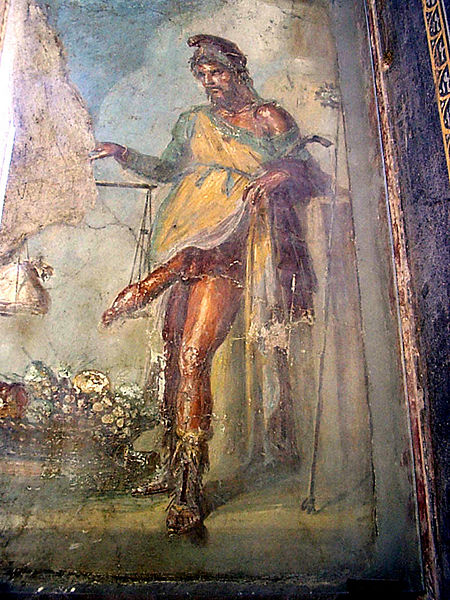
File:Priapus Fresco.jpg
http://www.newworldencyclopedia.org/entry/File:Priapus_Fresco.jpg
http://www.newworldencyclopedia.org/entry/Priapus

2012/05/02

Rosa Alchemica

Thought I'd pull this out - it's from the longer post on Jung, Tolkien, Hillman, Jackson, and likes to get lost. Wogga wogga stuff sure, but that's what speaks to wholeness in the psyche.


Seacht b-paidreacha fo seacht
Chuir Muire faoi n-a Mac,
Chuir Brighid faoi n-a brat,
Chuir Dia faoi n-a neart,
Eidir sinn 'san Sluagh Sidhe,
Eidir sinn 'san Sluagh Gaoith.

Seven paters seven times,
Send Mary by her Son,
Send Bridget by her mantle,
Send God by His strength,
Between us and the faery host,
Between us and the demons of the air.

from The Secret Rose, W.B.YEATS
[mike writes:
D'yer know how ter pronounce that?

SHOHT PAtri-ce fe SHOHT
HOOR MOIre fe na MAC
HOOR BRIhid fe na VROT
HOOR THEia fe ne NERT
EITHER SHIN sawn SLOOwe SHEE
EITHER SHIN sawn SLOOwe GOTh

...at least, where my lot stems from]


from Deborah:
The above prayer is from Yeats's prose work, The Alchemical Rose. It's the concluding story of the three, The Adoration of the Magi. It wasn't in the original Secret Rose, but was published privately and is contained in some later editions of TSR. This one is from the collected annotated version, 1972 I think. Hard to find.*

The lead-in passage is as follows:
This is all the old men told me, and when I think of their speech and of their silence, of their coming and of their going, I am almost persuaded that had I followed them out of the house, I would have found no footsteps on the snow. They may, for all I or any man can say, have been themselves Immortals: immortal demons, come to put an untrue story into my mind for some purpose I do not understand. Whatever they were, I have turned into a pathway which will lead me from the Order of the Alchemical Rose. I no longer live an elaborate and haughty life, but seek to lose myself among prayers and the sorrows of the multitude. I pray best in poor chapels, where the frieze coats brush against me as I kneel, and when I pray against the demons I repeat a prayer which was made I know not how many centuries ago to help some poor Gaelic man or woman who had suffered with a suffering like mine.


I look at the emblems in alchemy and -- well, here's a slew of obvious ones that have what hits me: You'll know them... but the literal image of the circle and square suggests, of course, the platonic cosmos model or the precession of the equinoxes we see in the old mechanical astrological model. But the others suggest the below when you translate the axiom into the neo-platonic modes of point, line, circle, sphere... and always individuation on the psych level. So it says to me, and I can't not see one or two old alchemists mumbling something along these scribbled lines through their beards. :)

Again --
Axiom of Maria. A precept in alchemy: "One becomes two, two becomes three, and out of the third comes the one as the fourth."

alice puts it:

Hidden in the Fourth is the One. Find it by uniting the Two in the Third.

masculine+feminine (expressed as metal, charge, planet, lovers, etc.) --transcending to-->divine nature/incarnation /big L love. Yin Yang stuff. Tao.

Jung (and these are psychological statements: Jung is always speaking of the psychological experience, and the psyche small and large is certainly the perspective of Yeats and his Celtic Twilight friend Fiona/ William Sharp ) used the axiom of Maria as a metaphor for the whole process of individuation.

From the Jung Lexicon: One is the original state of unconscious wholeness; two signifies the conflict between opposites; three points to a potential resolution; the third is the transcendent function; and the one as the fourth is a transformed state of consciousness, relatively whole and at peace.

The image language does suggest the Celtic Cross, which, like the axiom of Maria, is suggestive of the "squared circle"—which is to put a cross in the center of a circle, not to draw a circle in a square. That is — to divide it into quarters and thus make it a sphere, a notation for the Pythagorean fouth. Its very center is the perfect symbol for the psychological Stillpoint, where one penetrates the metaphor, passing beyond time and space to wholeness, the One. (An ever on-going process, for we are always moving, Time being a property of matter, the movement imaged/projected as Eros.) It is the image of the Self archetype (re Jung etc.) . The 4 corners, directions, dimensions; the Trinity with the female that is always implied, yet, rather than unconscious as she's been in the Christian system, she is conscious.

"When I think of Iona I think often, too, of a prophecy
once connected with Iona; though perhaps current no more in
a day when prophetical hopes are fallen dumb and blind.

"It is commonly said that, if he would be heard,
none should write in advance of his times. That, I do
not believe. Only, it does not matter how few listen.
I believe that we are close upon a great and deep spiritual change. I believe a new redemption is even now conceived of the Divine Spirit in the human heart, that is itself as a woman, broken in dreams, and yet sustained in faith, patient, long-suffering, looking towards home. I believe that though the Reign of Peace may be yet a long way off, it is drawing nigh; and that Who shall save us anew shall come divinely as a Woman, to save as Christ saved, but not, as He did, to bring with Her a sword. But whether this Divine Woman, this Mary of so many passionate hopes and
dreams, is to come through mortal birth, or as an
immortal Breathing upon our souls, none can yet know."

In Fiona MacLeod's (William Sharp) above statement, she comes NOT with a sword. Instead, she IS the sword.(*This, the conjugate of the male—and the conjugate is always present in the balance of forces inherent in the conditions of LIFE.) The Lady of Lake can be read as this principle: rather than the destructive force ("dissolve", putrefactio), she is the uniting force. Symbiosis: the principle of what endures in nature (Wilde's 'under the conditions of matter'). A psychological statement.

Again, Art functions as herald. As with Ficino's translations of Plato, it seems Thomas Taylor's translations into English of Plato, the later Platonists, Orphics and Pythagoreans rebirthed a second Renaissance: Romanticism. As it morphed into Aestheticism and Celtic Twilight, I'm thinking also of Wilde's flirtations with ritual re Catholicism; the Oxford Movement; Rossetti's goddess worship/Marianism, Neoplatonism, 'the Art Catholic'; and the continuing fascination of that big R Romanticism of Shelley, Keats, etc., to this day. These seem to reflect the conscious restoration of Ritual/magic, 'mysticism'/mystery to the West. All foreshadow; they are the compensations that paved the way for the formal development of psychology and psychical research re James, Freud/Jung etc. The conscious recognition of the unconscious.

Or so it seems to me.


x's Deborah

*full pdf version here: http://www.golden-dawn.com/fr/UserFiles/en/file/pdf/adoration_of_the_magi.pdf

Rosa Alchemica

Thought I'd pull this out - it's from the longer post on Jung, Tolkien, Hillman, Jackson, and likes to get lost. Wogga wogga stuff sure, but that's what speaks to wholeness in the psyche.


Seacht b-paidreacha fo seacht
Chuir Muire faoi n-a Mac,
Chuir Brighid faoi n-a brat,
Chuir Dia faoi n-a neart,
Eidir sinn 'san Sluagh Sidhe,
Eidir sinn 'san Sluagh Gaoith.

Seven paters seven times,
Send Mary by her Son,
Send Bridget by her mantle,
Send God by His strength,
Between us and the faery host,
Between us and the demons of the air.

from The Secret Rose, W.B.YEATS
[mike writes:
D'yer know how ter pronounce that?

SHOHT PAtri-ce fe SHOHT
HOOR MOIre fe na MAC
HOOR BRIhid fe na VROT
HOOR THEia fe ne NERT
EITHER SHIN sawn SLOOwe SHEE
EITHER SHIN sawn SLOOwe GOTh

...at least, where my lot stems from]


from Deborah:
The above prayer is from Yeats's prose work, The Alchemical Rose. It's the concluding story of the three, The Adoration of the Magi. It wasn't in the original Secret Rose, but was published privately and is contained in some later editions of TSR. This one is from the collected annotated version, 1972 I think. Hard to find.*

The lead-in passage is as follows:
This is all the old men told me, and when I think of their speech and of their silence, of their coming and of their going, I am almost persuaded that had I followed them out of the house, I would have found no footsteps on the snow. They may, for all I or any man can say, have been themselves Immortals: immortal demons, come to put an untrue story into my mind for some purpose I do not understand. Whatever they were, I have turned into a pathway which will lead me from the Order of the Alchemical Rose. I no longer live an elaborate and haughty life, but seek to lose myself among prayers and the sorrows of the multitude. I pray best in poor chapels, where the frieze coats brush against me as I kneel, and when I pray against the demons I repeat a prayer which was made I know not how many centuries ago to help some poor Gaelic man or woman who had suffered with a suffering like mine.


I look at the emblems in alchemy and -- well, here's a slew of obvious ones that have what hits me: You'll know them... but the literal image of the circle and square suggests, of course, the platonic cosmos model or the precession of the equinoxes we see in the old mechanical astrological model. But the others suggest the below when you translate the axiom into the neo-platonic modes of point, line, circle, sphere... and always individuation on the psych level. So it says to me, and I can't not see one or two old alchemists mumbling something along these scribbled lines through their beards. :)

Again --
Axiom of Maria. A precept in alchemy: "One becomes two, two becomes three, and out of the third comes the one as the fourth."

alice puts it:

Hidden in the Fourth is the One. Find it by uniting the Two in the Third.

masculine+feminine (expressed as metal, charge, planet, lovers, etc.) --transcending to-->divine nature/incarnation /big L love. Yin Yang stuff. Tao.

Jung (and these are psychological statements: Jung is always speaking of the psychological experience, and the psyche small and large is certainly the perspective of Yeats and his Celtic Twilight friend Fiona/ William Sharp ) used the axiom of Maria as a metaphor for the whole process of individuation.

From the Jung Lexicon: One is the original state of unconscious wholeness; two signifies the conflict between opposites; three points to a potential resolution; the third is the transcendent function; and the one as the fourth is a transformed state of consciousness, relatively whole and at peace.

The image language does suggest the Celtic Cross, which, like the axiom of Maria, is suggestive of the "squared circle"—which is to put a cross in the center of a circle, not to draw a circle in a square. That is — to divide it into quarters and thus make it a sphere, a notation for the Pythagorean fouth. Its very center is the perfect symbol for the psychological Stillpoint, where one penetrates the metaphor, passing beyond time and space to wholeness, the One. (An ever on-going process, for we are always moving, Time being a property of matter, the movement imaged/projected as Eros.) It is the image of the Self archetype (re Jung etc.) . The 4 corners, directions, dimensions; the Trinity with the female that is always implied, yet, rather than unconscious as she's been in the Christian system, she is conscious.

"When I think of Iona I think often, too, of a prophecy
once connected with Iona; though perhaps current no more in
a day when prophetical hopes are fallen dumb and blind.

"It is commonly said that, if he would be heard,
none should write in advance of his times. That, I do
not believe. Only, it does not matter how few listen.
I believe that we are close upon a great and deep spiritual change. I believe a new redemption is even now conceived of the Divine Spirit in the human heart, that is itself as a woman, broken in dreams, and yet sustained in faith, patient, long-suffering, looking towards home. I believe that though the Reign of Peace may be yet a long way off, it is drawing nigh; and that Who shall save us anew shall come divinely as a Woman, to save as Christ saved, but not, as He did, to bring with Her a sword. But whether this Divine Woman, this Mary of so many passionate hopes and
dreams, is to come through mortal birth, or as an
immortal Breathing upon our souls, none can yet know."

In Fiona MacLeod's (William Sharp) above statement, she comes NOT with a sword. Instead, she IS the sword.(*This, the conjugate of the male—and the conjugate is always present in the balance of forces inherent in the conditions of LIFE.) The Lady of Lake can be read as this principle: rather than the destructive force ("dissolve", putrefactio), she is the uniting force. Symbiosis: the principle of what endures in nature (Wilde's 'under the conditions of matter'). A psychological statement.

Again, Art functions as herald. As with Ficino's translations of Plato, it seems Thomas Taylor's translations into English of Plato, the later Platonists, Orphics and Pythagoreans rebirthed a second Renaissance: Romanticism. As it morphed into Aestheticism and Celtic Twilight, I'm thinking also of Wilde's flirtations with ritual re Catholicism; the Oxford Movement; Rossetti's goddess worship/Marianism, Neoplatonism, 'the Art Catholic'; and the continuing fascination of that big R Romanticism of Shelley, Keats, etc., to this day. These seem to reflect the conscious restoration of Ritual/magic, 'mysticism'/mystery to the West. All foreshadow; they are the compensations that paved the way for the formal development of psychology and psychical research re James, Freud/Jung etc. The conscious recognition of the unconscious.

Or so it seems to me.


x's Deborah

*full pdf version here: http://www.golden-dawn.com/fr/UserFiles/en/file/pdf/adoration_of_the_magi.pdf

2011/09/13

Carl Jung


"Where love reigns, there is no will to power; and where the will to power is paramount, love is lacking. The one is but the shadow of the other..."
~CGJung, The Problem of the Attitude-Type, CW7


At first we cannot see beyond the path that leads downward to dark and hateful things -- but no light or beauty will ever come from the man who cannot bear this sight. Light is always born of darkness, and the sun never yet stood still in heaven to satisfy man's longing or to still his fears. ~C.G. Jung, Modern Man In Search of a Soul

The psychic depths are nature, and nature is creative life. Whatever values in the visible world are destroyed by modern relativism, the psyche will produce their equivalents.
~C.G.Jung, Modern Man in Search Of a Soul


The artist is not a person endowed with free will who seeks his own ends, but one who allows art to realize its purposes through him.
~C.G.JUNG --Modern Man In Search Of A Soul


The work of the poet comes to meet the spiritual need of the society in which he lives, and for this reason his work means more to him than his personal fate, whether he is aware of this or not. ~C.G. Jung, Modern Man In Search Of A Soul

By a symbol I do not mean an allegory or a sign, but an image that describes in the best possible way the dimly discerned nature of the spirit. A symbol does not define or explain; it points beyond itself to a meaning that is darkly divined yet still beyond our grasp, and cannot be adequately expressed in the familiar words of our language.
~CGJUNG Spirit and Life, CW8, 1926, para 644,


Ultimately, every individual life is at the same time the eternal life of the species.
~CG Jung Memories, Dreams, Reflections


When we set out to interpret a dream, it is always helpful to ask: what conscious attitude does it compensate?
~C.G.Jung The Practical Use Of Dream Analysis Collected Works Vol. 16


The psyche is a self-regulating system that maintains its equilibrium just as the body does. Every process that goes too far immediately and inevitably calls forth compensations, and without these there would be neither a normal metabolism nor a complete psyche. C.G.JUNG The Practical Use Of Dream Analysis,Collected Works Vol. 16

One thing we ought never forget: almost half our life is passed in a more or less unconscious state. The dream is specifically the utterance of the unconscious.
~CGJUNG CW16


....only the paradox comes anywhere near to comprehending the fullness of life. Non-ambiguity and non-contradiction are one-sided and thus unsuitable to express the incomprehensible.
~CG Jung Introduction to the Religious and Psychological Problems of Alchemy, Collected Works Volume 12


The unconscious is not a demonical monster, but a natural entity which, as far as moral sense, aesthetic taste, and intellectual judgement go, is completely neutral. It only becomes dangerous when our conscious attitude to it is hopelessly wrong. To the degree that we repress it, its danger increases.
~C.G.Jung The Practical Use Of Dream Analysis, Collected Works Vol. 16


It has yet to be understood that the Mysterium Magnum is not only an actuality, but is first and foremost rooted in the human psyche.
~CG Jung Introduction to the Religious and Psychological Problems of Alchemy, Collected Works, Vol. 12


Nobody doubts the importance of conscious experience; why then should we doubt the significance of unconscious happenings? They also are part of our life, sometimes more truly a part of it for weal or woe than any happenings of the day.
~CGJUNG CW 16


The unconscious is a Janus-face: on one side its contents point back to a preconscious, prehistoric world of instinct, while on the other side it potentially anticipates the future.
~C.G.Jung Conscious, Unconscious, and Individuation


It makes no difference if the poet knows that his work is begotten, grows and matures with him or whether he supposes that by taking thought he produces it out of the void.

The creative process has a feminine quality, and the creative work arises from unconscious depths -- we might say, from the realm of mothers.

There can be no doubt that from the beginning of the nineteenth century -- from the memorable years of the French Revolution onwards -- man has given a more and more prominent place to the psyche, his increasing attentiveness to it being the measure of its growing attachment for him. The enthronement of the Goddess of Reason in Notre Dame seems to have been a symbolic gesture of great significance in the Western world -- rather like the hewing down of Woton's oak by Christian missionaries. For then, as at the revolution, no avenging bolt from heaven struck the blasphemer down.
~CGJUNG

". . . .Then, what could love be?' I asked. 'A mortal?'
. . . . 'He's like we mentioned before,' she said. 'He is in between mortal and immortal.'
'Wotcher mean, Diotima?'
'He's a spirit, Socrates. Everything spiritual, yer see, is in between god and mortal.'
'What's their function?' I asked.
'They are messengers. . . . " ~Plato, Symposium 

2012/09/17

cant redux and how it started, redux


cant n.

  1. Angular deviation from a vertical or horizontal plane or surface; an inclination or slope.
  2. A slanted or oblique surface.
  3. A thrust or motion that tilts something.
  4. The tilt caused by such a thrust or motion.
  5. An outer corner, as of a building.
— n

  1. insincere talk, esp concerning religion or morals; pious platitudes
  2. stock phrases that have become meaningless throughrepetition
  3. specialized vocabulary of a particular group, such asthieves, journalists, or lawyers; jargon
  4. singsong whining speech, as used by beggars
  5. — vb.( intr ) to speak in or use cant
 [C16: probably via Norman French canter  to sing, fromLatin cantāre;  used disparagingly, from the 12th century,of chanting in religious services]
*********

Look under the toe of your boot. There's a quarter there.

I find 4 leaf clovers, sometimes 5 leaf clovers... But my eye is trained to find them. It honed itself hunting shark teeth in the cliffs of the Chesapeake. You get attuned, is all.

Not that things aren't connected.

I heard a terrific explanation of quaternity someone gave ala marie von franz (who was a dear friend of alice's):


Axiom of Maria. A precept in alchemy: "One becomes two, two becomes three, and out of the third comes the one as the fourth."
alice puts it:
Hidden in the Fourth is the One. Find it by uniting the Two in the Third.
Which is cant (jargon-leaning version) for:
masculine+feminine (expressed as metal, charge, planet, lovers, etc.) -- transcending to--> divine nature/incarnation /big L love. Yin Yang stuff. Tao. It's the cornerstone of alchemy. The power to transform.

Carl Jung (and these, like all things religious, are psychological statements: Jung is always speaking of the human psychological experience) used the axiom of Maria as a metaphor for the whole process of individuation. From Sharp's Lexicon: One is the original state of unconscious wholeness; two signifies the conflict between opposites; three points to a potential resolution; the third is the transcendent function; and the one as the fourth is a transformed state of consciousness, relatively whole and at peace.

(Jung smokes his pipe and grins. "I was only in it for the transference.")

The oddest things can take on the transcendent function...

At our old house, there was a swing my kids made by throwing a rope over a tree half-way up our front yard. It set the stage above our little stone amphitheater here to tell this tale.

My youngest son left a chair up there by the swing. Odd old chairs left around the property. They add charm. And I'm not sure who they belong to, who sits in them. Like the old tribes in the desert, the chair is dragged from place to place that it might be a portable holy of holies. (Such was the arc of the covenant, oddly enough.) But -- this new chair sits there happily, covered with shade, the entire hill covered with great trees all the way to the split rail fence, looking very Cold Mountain --which it is. The sun comes up here at an angle through the tall trees at the edge of the ridge. It has to slant in here, Helios, Ra, Apollo, Sun Sun Sun. He's magnificent in his coming, sending out spears and rays and solid golden ladders. Morning is a wondrous happy thing. But I noticed as I got in the car that He also found my son's chair up there in the darkness. He shines on it, sits there like a beautiful prince.


So that's who sits in that chair.

But the tale... I stopped at a park one day to pick up my son from soccer practice. All around the huge field is (surprise, surprise) beauty. More Ra and his rays, mountain framed, rocks that climb the hills in tiffany and yager cut layers. I talked with another woman waiting there. She's a Richmond native, I find, and she mentions that her child goes to the local Christian School. We talk about the history around us, the war, the Reservists who have all been called up and will be gone for so long, and she says, after a pause, -- "My mom was saying the other day that she just wished that the Rapture would come and be over with!" And so I looked at her, and said what honestly came to me.

It was that scripture about the doubting Thomas, Jesus asking him if he must put his hands in his wounds to Gnow (though I think I said 'believe'). "Why can't people listen to that?" I asked her. "It's so simple. Is it the blood and wounds that are important or is the message that lives in the heart? Where do you believe? With hands and blood and eyes, or the heart? Because that's the incarnation. That's the "Rapture" fulfilled, and everyone can have it right now by letting the Christ (Ra, Apollo, Buddha consciousness, higher love, universal moral principles ... your theory here) live in the heart, without middlemen or magic books or politics. You just look into someone's eyes and see (don't you know me?) the Christ there. And you incarnate, Christ in you."

She seems to like this.

I guess she'll go ask her pastor about it. He'll tell her I'm the devil.

Anyway, Temple is everywhere. You just have to recognized it. 

As for my Eros cant, I'll caution you. Priapus is now often confused with Eros, but Priapus was an object of pity, a walking parable of a huge insatiable throbbing and utterly painful wang always obscuring His way. But even Priapus has a place, a time. He carries the child over into the horrors of manhood, where the waters rage and seethe and ache -- until Eros is found within all.

2011/06/08

alchemy in reverse


Funny, those cute little dinosaurs, plastic and colorful, sold in sets complete with plastic rocks, palm trees, and cave people. Plastic. Hydrocarbons are miracles when it comes to building things, even in producing life-saving vaccines, antibiotics, and the syringes used to squirt them into our bodies. We need them. But we don't need them to keep transporting us and heating us when they create such havoc, are in limited supply, and are both politicized and the force behind self-perpetuating technologies. Think of the electric car and how it was first received. Think of the failed (because dismantled) energy programs Congress crafted in the 70's. Think of Reagan smiling as he took down the solar panels on the White House roof.

By manipulating a myth (and religion) of a free-market, owners of Oil have long worked to dig our social and technological trenches deeper. The interstate highway system was built at taxpayers' cost, while rail and public-transit paid their own way. Hence the suburbs and all the trimmings. The manicured lawns, ever-growing to accommodate the even bigger houses, status symbols enforced by vigilante neighbors watching out the window. A life style defined by commerce, the car as one's self-definition.

And now it continues, pedal to the metal, the blatant thwarting of alternatives embedded in political parties and whole media networks, religious crusades sold to us, and will continue be as sold to us as long as the sweet crude flows in the Biblical deserts. Obama, whose stimulus was centered on a revolution of developing alternative energy, has been literally demonized and castrated by it. Stimulus money still sits unspent, and no one seems to know that, though I suspect projects will be rolled out in time for the Party of No to take credit for them.

Worst of all -- worst of all -- the fracking has begun, sold quietly behind the scenes, unwatched. How lucky we are, discovering our own stash of hydrocarbons right beneath our feet! Why throw tax-payer money at wind or solar? At all costs, we need to pay down the deficit, let the mighty keep their taxes low, for everyone knows they "give" you your paycheck! Never mind that work doesn't work without workers.

And it's not just the US. The myths rule, and the creditor nations rule all. Krugman wrote yesterday
What I guess I’d say is that the creditor-oriented mindset permeates the whole world of men in suits sitting around tables talking policy. And the world will suffer for it.

Black gold, that's what oil has been. Civilization as alchemy in reverse.

alchemy in reverse


Funny, those cute little dinosaurs, plastic and colorful, sold in sets complete with plastic rocks, palm trees, and cave people. Plastic. Hydrocarbons are miracles when it comes to building things, even in producing life-saving vaccines, antibiotics, and the syringes used to squirt them into our bodies. We need them. But we don't need them to keep transporting us and heating us when they create such havoc, are in limited supply, and are both politicized and the force behind self-perpetuating technologies. Think of the electric car and how it was first received. Think of the failed (because dismantled) energy programs Congress crafted in the 70's. Think of Reagan smiling as he took down the solar panels on the White House roof.

By manipulating a myth (and religion) of a free-market, owners of Oil have long worked to dig our social and technological trenches deeper. The interstate highway system was built at taxpayers' cost, while rail and public-transit paid their own way. Hence the suburbs and all the trimmings. The manicured lawns, ever-growing to accommodate the even bigger houses, status symbols enforced by vigilante neighbors watching out the window. A life style defined by commerce, the car as one's self-definition.

And now it continues, pedal to the metal, the blatant thwarting of alternatives embedded in political parties and whole media networks, religious crusades sold to us, and will continue be as sold to us as long as the sweet crude flows in the Biblical deserts. Obama, whose stimulus was centered on a revolution of developing alternative energy, has been literally demonized and castrated by it. Stimulus money still sits unspent, and no one seems to know that, though I suspect projects will be rolled out in time for the Party of No to take credit for them.

Worst of all -- worst of all -- the fracking has begun, sold quietly behind the scenes, unwatched. How lucky we are, discovering our own stash of hydrocarbons right beneath our feet! Why throw tax-payer money at wind or solar? At all costs, we need to pay down the deficit, let the mighty keep their taxes low, for everyone knows they "give" you your paycheck! Never mind that work doesn't work without workers.

And it's not just the US. The myths rule, and the creditor nations rule all. Krugman wrote yesterday
What I guess I’d say is that the creditor-oriented mindset permeates the whole world of men in suits sitting around tables talking policy. And the world will suffer for it.

Black gold, that's what oil has been. Civilization as alchemy in reverse.

2013/02/26

cant

I am poem hungry today. Must be starting off with the Black Narcissus, his initiation (oh: read) (and Oh! The roses! I have a rather bold comment hidden there as museredux...)

From my archives

Deborah:

Date: Tue Oct 17, 2000 3:06 pm Subject: Re: [Negative-Capability] in the beginning


Search my soul here: No beliefs to speak of. But thinking: I instinctively try to see the divinity in everything. Blooming simply to bloom.

This path is just an approach, an act. A way to move, because we are creatures of movement. We have different ways of seeing the same thing. Paths. I'm understanding that I really have no religion but that. Just my heart's direct experience and opening to it.

Just a pragmatic 'looking at the mask'. And Beauty -- that's just Eternity perceived in the old myth -- the memory of being beyond time and movement *where there isn't even silence and stillness.*

My kids ask if there's a god, and I say yes! It's what all this is, where it all came from and goes to. What is it-they-neuter no-English-word-to-even-ask-the-question? Well, that's just a way humans have... wanting to know why and where, etc. But this simply is. 'Being' really was a good way to put it.

Just a grasping of Being. Personifications are poetry and grasping. Truth and Beauty: always coming and slipping away. You can't possess anything in time/space. And matter doesn't exist anywhere else. So physics tells us.


e.g..: I see Pico della Mirandola's sigil reads Love is Passion aroused by Beauty. I am fascinated. I ask--stars fill me with the vision--How does Beauty arouse us? Move us, set us aflame? Make us live, animate? Each word is essential to grasp. Love is Eros. Whole books on that. Beauty as Keatsian truth and beauty, Beauty as form, Beauty as archetype, Beauty as Sephirah, and especially Beauty re Eros traced back before Plato--because Plato as the origin of all things is the great lie of the West--fascinates me. Fascination is a demon. Demons are teachers. I sit down and try to be full and empty enough to be filled. That's the upsurging draft, the arousal. Life.

I suppose that sort of exploration becomes my practice of religion. It's a thing hidden in my soul that urges me on, a process. Lucifer, bringing light, bringing darkness in the time between dawn and sunrise. Midnight and the new night's morning.

Oddly, irritability seems a natural and essential condition of creativity. Without it, we only have abiding, which doesn't belong in time/space. Stuck in Eros, we have nothing at all. Torque is the word I use for irritability. Says it for me. It means beingness: being in time. Moving toward Being. Ah: Love is Passion aroused by Beauty.

I do think -- and if I have a prejudice, this is it, because it's been the experinece I've lived and that defines me -- that all religions began this way. With this search in the heart. The search creates the truth is all I can really say about it honestly. That's descriptive, mind you. Not anything belived or writ in stone. More writ in water. Write it all in water.


~~~~

Beautiful Daimons, all.

From: Deb Date: Tue Nov 14, 2000 2:15 pm Subject: Myth again

Notes:

(Diotima, the Matte'i essay and the Symposium. etc.)

Symposium was the prime myth of the Renaissance (and Wilde, Pater, Rossetti, Keats) (Important also because: it shows Platonism of Jung. Truth in wine and children!)

Forms as archetype, collective unconscious as the Masks of God. Each affects/reflects/creates the other: It's a dance: A sacred marriage of Becoming.

Archetype: a priori intuition expressed as instinctual image.

Art of Becoming: Pairs of relationships: A dialectic.

Word and thing: The main business of magick is the search for the original language that perpetuated the cosmos is this relationship. The perfect word or symbol and their systems of relationships, e.g. Language, or form (Kabbalistic sefiroth, sacred geometry, Ars Memory...) .always about word and thing: that is, the creation or generation or relationship between word and thing. Apollonian and Dionysian; Whole and Part; Syncretism and Analytical. Anabolic and catabolic. Anode and cathode. Time and moment. Being and Becoming.

All carry the same language as the early Eros myth: Eros: son of chaos, the creator, the mover, the shaper; hangs out with Desire and Longing. Dance: Shape and shaper. Created /creator. Love and Beloved. Penetrator and penetrated. AhHa and before AhHa. Memory and Soul.

Eros and Beauty: mediated by memory.

Drama and theater as The Self:

The stage the center of the dance between the gods and man; archetype and the psyche. Both wear masks, make masks for each other, project & reflect masks, inotherowords: create the other. Also idea of sphere as theater: the stage as the Center which is everywhere, circumference Nowhere. As god/Self. Unconscious/conscious.

Greeks understood this. So did Oscar. And Nietzsche and Rossetti and Keats and Lawrence and Hardy et al. The prime Romantic myth.

Beauty as mediator between Time and Eternity.
Beauty as Mercurious, as Daimon.
Beauty as mediator between archetype/forms/eternity and becoming.
Beauty as Truth, Truth as Beauty
Never separate: always both at once. Self. The deity dressed in
time/space/matter.

(Seing this frees it. "For I am redeemed by Art" )
x's Deborah

From: mike
Date: Tue Nov 14, 2000 3:06 pm
Subject: Re: [Negative-Capability] Myth again

You might be interested in the following

http://socrates.philosophy.msstate.edu/pr/Faculty/papers/digges.html


and in the discussion on Dee and Digges and Copernicanism on the alchemy list

Otherwise, take a look at the archives which are at http://www.levity.com/alchemy/a-archive1.html

Love,

me

cant

I am poem hungry today. Must be starting off with the Black Narcissus, his initiation (oh: read) (and Oh! The roses! I have a rather bold comment hidden there as museredux...)

From my archives

Deborah:

Date: Tue Oct 17, 2000 3:06 pm Subject: Re: [Negative-Capability] in the beginning

2013/08/24

mirrored in the wave

The symbols, hidden, painted over. The beauty lost to us. The deepest part of what we are and what we've come from.

In: CW v. 9.2: Aion: researches into the phenomenology of the self (p. 126-137 ).

The associations of the fish in alchemical, Christian and psychological symbolism are discussed. The fish in alchemical texts prior to the 11th century is found to be identified with the lapis philosophorum, considered psychologically as a complex symbol of the self. Numerous references appear to the fish glowing from an inner fire of a dual nature represented both as the light of divine grace and as the fires of hell. This type of dualism is noted to have occurred frequently in medieval symbolism, but without any apparent awareness of the unity of opposing forces such a dual nature implies. An investigation of the complex network of archetypal symbols in alchemy reveals its close correspondence with the structure of the psyche; in particular, the unity of hell and God as the source of the world is seen to be parallel to the unified source of all disparate psychic operations, whether they are creative or destructive.

Collected Works of C.G. Jung


wiki:
Taijitu, the traditional symbol representing the forces of Yin and Yang
The concepts of yin and yang originate in ancient Chinese philosophy and metaphysics, which describes two primal opposing but complementary forces found in all things in the universe. Yin, is sad, the darker element, is passive, dark, feminine, downward-seeking, and corresponds to the night; Yang, is happy, the brighter element, is active, light, masculine, upward-seeking and corresponds to the day; yin is often symbolized by water, while yang is symbolized by fire.
The pair probably goes back to ancient agrarian religion; it exists in Confucianism, and it is prominent in Taoism. Though the words yin and yang only appear once in the Tao Te Ching, the book is laden with examples and clarifications of the concept of mutual arising. The concept is a fundamental principle of Traditional Chinese Medicine.
Yin and yang are descriptions of complementary opposites rather than absolutes. Any yin/yang dichotomy can be seen as its opposite when viewed from another perspective. The categorisation is seen as one of convenience. Most forces in nature can be seen as having yin and yang states, and the two are usually in movement rather than held in absolute stasis.


---------

Now go read Hesioid, the Eros myth. And this...

"Hades and Hephaestus: on the surface they are two very different gods with nothing to connect them. But the apparent gulf between them rapidly disappears as soon as we look a little more closely at what the second of these gods will have meant, not for us but for Empedocles. The mythology and cult of Hephaestus spread to the rest of the Greek world from the north-east Mediterranean, where he appeared to have associations with the subterranean—specifically volcanic—fire. His transference westwards to Sicily was evidently not via the Greek mainland, but direct. There, in Sicily, he took over the cult and attributes of an indigenous non-Greek god, Adranus: Adranus had his temple on the edge of Mt. Etna, with a sacred grove and a fire ‘that was never extinguished and never died down.’ It was here in the West—in Sicily and the surrounding islands—that Hephaestus’ connections with fire expressed themselves most overtly in the form of direct connection with volcanic fire. On Lipara he was the chief god of the island, and personification of the volcano; Themessa, between Limpara and Sicily, was known as Hiera because—at least in historical times—it was considered sacred to Hephaestus. On Sicily itself, and in the immediate vicinity of Empedocles’ town of Acragas, the was the ‘hill of Hephaestus’: a local cult center where the god was believed to make his presence under the hill known by extraordinary feats of spontaneous combustion. But above all Hephaestus was connected with Mount Etna, not just in Sicilian cult and myth, but in classical tradition right down to the end of antiquity. There, underneath the earth, was his home—and especially his workplace. The common reluctance to give this fact its due significance is a result of failing to appreciate that, in spite of Hephaestus’ formal inclusion in the Olympian pantheon, he essentially never lost his role as a god of the inner depths of the earth. In short, any seeming inconsistency in Empedocles’ referring to fire now as Hades, now as Hephaestus is itself just one more pointer in the direction of that underworld.

"Hades and Hephaestus, the destructive and creative: to place these two aspects of Empedocles’ fire in their true perspective we need finally to set them against the background of the idea so common in antiquity, that the underworld is a place of paradox and inversion. In particular it is a place where polar opposites coexist and merge, and especially the place where the paradox of destructive force being converted into creative power is realized as its greatest intensity. Two thousand years of classical tradition relating to volcanoes—primarily Etna—and the underworld are summed up by Milton’s Lucifer: ‘Here in the heart of Hell to work in Fire.’ This is not to quote Milton as direct evidence for ideas held by Empedocles but, once again, simply to emphasize the resilience and endurance of a tradition which classicists who treat Empedocles as a ‘philosopher’ ignore at their peril. Milton himself equated Lucifer with Hephaestus, and there was no shortage of descriptions in ancient literature of the extraordinary effects produced by Hephaestus as he works with the volcanic fire inside the earth. That this particular association of ideas was known to Empedocles is undeniable: to gain some impression of how important it was in shaping his cosmology, we have only to look at how he described the creation of the ancestors of men and women. On the one hand, the way in which he words his account of their formation inside the earth is plainly meant to invoke Hesiod’s famous description of Hephaestus creating Pandora. On the other hand, his image of humanity being spewed up by fire shooting into the sky is an obvious example of volcanic imagery. In Sicily, Hades and Hephaestus are two sides of one and the same coin: two aspects of the volcanic fire just inside the earth."
~from Peter Kingsley,
Ancient Philosophy Mystery, and Magic Empedocles and the Pythagorean Tradition
book at amazon

2011/07/30

Carl Jung

I've always felt Jung's approach was empirical from the standpoint of a physician. Equilibrium, homeostasis, as in functioning as compensation and complement, as between unconscious and consciousnesses (which holds up well as we're realizing that we actually think in the unconscious and later sort out our arguments -- same for memory; we re-create it. Re-member it) . The key is to consider the psyche as real as any physical thing, just as we accept energy and matter as both "real". The unknown forces at play -- as with physics, the quantum critical mass, etc. -- also part of the exploration.

Empiricism as we apply it concerns making models. Always incomplete, never the thing itself. Think of how code works on the internet now: computers jump ahead, see patterns without models. As with our thinking, I suspect (the processing done in the unconscious), though our awareness(consciousness) functions on the Newtonian level in what we describe as the everyday "common sense" world. Empiricism augments and extrapolates beyond the mere, the sensual. Jung expands our tool kit like a Tardis. :)

Jung, truly a philosopher in the old sense: lover of wisdom, trained in the Muses, a healer and a teacher. This is a good grounding:

Maureen writes:

Dear Lovely & Beloved Deborah & Alice

[...]
Jung looks at the source energy as Pleroma (Seven Sermons to the Dead), Tao (I Ching), unus mundus (alchemy) - all names for a Ground of Being that is unexpainable but can be experienced through intuition, mysticism, creativity, ecstasy and love. Because Eros is gaining the upper hand again through Aquarian holism, Eastern and Western thought have already come together to some extent through the new kind of understanding coming out of quantum physics - the realization of the interrelatedness of all and the archetypal links between psyche, creativity and science.

OF (Jung as 'Old Fool') had no preference for 'logical' over its opposite - the world as infinite and incomprehensible. As a 'whole-some' individual, he embodied the dance of opposites. I love him because he's a guy after my own heart. I was the only bod at my high school and at Uni who leaned toward neither the arts or science, so I embraced both, while everyone else did one or the other. Both are, after all, underpinned by the same archetypal energies and so have always been two sides of the one coin of truth, as wholistic thinkers like Bohm and Pauli understand. Ditto for Jung, a self-proclaimed 'scientist of soul' - and as we all know, soul can't be objectified, weighed, analysed, explained, or in any other way dissected, or pinned like a dead butterfly. Neither can a star, or a leaf, or an atom for that matter. Is a star merely a big ball of flaming gas, or is that simply what it's made of? Jung was not 'scientifically grounded' if by that we mean someone who tries to reduces the poetry and mystery of life to rational, stagnant, objective facts and cerebral explantions.

As OF made clear, at least half of life is irrational! Someone once asked him why the Chinese had developed no 'science'. He replied that this was an optical illusion, since they had a science - the I Ching - grounded in 'general synchronicity' - the understanding that psyche and nature mirror one another meaningfully, as inseparable twin facets of a unitary ground of being. This was the only kind of science that Jung had time for - he didn't buy into the Western hubris of trying to tame and reduce life to the 'myth' of objectivity and 'scientific theory'. Science, after all, simply means 'knowledge'. As Jung reminds us, we can never know the 'ding an sich' - the thing in itself - since all our knowledge - ALL of it - is experienced through the lens of the psyche. All of Jung's ideas are based on this kind of direct experience of the world through the lens of soul.

Anyway, my ramblings to toss into the Fire.

2011/07/16

ever in search

from the Masonic hall in Staunton, VA


from my notes on Masonry:

Benjamin Franklin and his broad Deist Enlightenment perspective led him to speak a language more symbolic / poetic than today's--yet it was perfectly understood in his time. I keep thinking of Walter Isaacson's description of Franklin's funeral... all the clergy from the entire city marched at the front with his coffin--the Rabbi with them. It says everything about Franklin, and everything about what our current leaders and their castrati of press would like us to lose.
In every town I drive through, I look for and often find the Masonic emblem. I understand what an important role they played in carrying Enlightenment views though this nation. They were long the civic backbone, a place where all the clergy could 'walk together' and meet as men, all dogma realized as symbol and ritual. Too often written out of serious history, what a great loss to lose this perspective.

Seems to me that FreeMasonry was sometimes the one place in this commercialgodobsessed nation where different denominations and parties might come together, seeing we are really all made alike, hands, feet, head, soul, notions, fears, hopes, failings... Why not enlighten each other's way?
How to join
Freemasonry Today
Anyone interested in Masonry and its history will find the articles in the Eighteenth-Century Studies Journal vol 33 number 2 , Johns Hopkins Univ Press, helpful. To paint all masonry as diabolical -- some NWO -- is absurd. The US Constitution is essentially a Masonic document. Separation of religion and state (the original wording) was the very core of Masonry in that age.
Masonry and its history: Eighteenth-Century Studies Journal vol 33 number 2 , Johns Hopkins Univ Press.

Jacob,Margaret C. Living the Enlightenment: Freemasonry and Politics in Eighteen-Century Europe . Oxford University Press: New York, 1991.
Jacob provides an insight into how Freemasons, in their private sociability, reconstituted polity and established a constitutional form of self-government complete with laws, elections and representatives. Moral, ethical and political prescriptions permeating Masonic rituals and discourse is thoroughly examined. Freemasonry wove Enlightened ideas into a tapestry of rituals and oaths; rules of conduct intended to induce loyalty and civility for its dedicated followers—promoting socially acceptable virtues. Also mentioned are Freemason utopian, reforming and free-thinking tendencies (Benjamin Franklin among a few). Jacob explains the exclusion of women in Freemasonry and the anti-masonic trends.
Pedicord, Harry W. “Masonic Theatre Pieces in London 1730-1780.” Theatre Survey. 25 (1984), 153-166. Freemasonry as a vital force in the theatrical scene both before and behind the stage curtain; 18th century. Pedicord gives a compilation of plays, operas and song that were predominately Masonic in theme. Among the pieces are an Opera, “The Generous Free- Mason,” a tragedy, “The London Merchant,” and a drama, “Harlequin Freemason.” Each reflect the traditions and teachings of Freemasonry. All pieces are broken down scene by scene and explained. Samples of reviews in magazines and newspapers are also included.
Roberts, Marie. British Poets and Secret Societies. Barnes and Noble Books: Totowa New Jersey, 1986. A compilation of works of 18th century poetry on the subject of Freemasonry. This book investigates the relationship between poets and secret societies; mainly Freemasonry. Included in the compilation are writings by Rudyard Kipling. The involvement of the poets with the Freemason Brotherhood is also examined. The poems include all aspects of Freemasonry; from their philosophy and practice to their rituals and dress. Each poem is broken down and interpreted, making this interesting reading even for those unfamiliar with Freemasory.
http://www.louisville.edu/a-s/english/subcultures/colors/black/bljett01/farebiblio.html


http://www.levity.com/alchemy/poznan.html
"The Library of the University of Poznan possess an exceptional collection of Masonic books amounting to about 80,000 volumes. This collection was originally formed during World War II when Heinrich Himmler's SS under the Nazi regime in Germany confiscated the libraries of Masonic libraries in Germany, and stored this archive in Poland. After the war this collection remained in Poland, and only since the fall of the communist regime has its existence been known or it been given any publicity.
It is the largest Masonic collection in continental Europe and second only to that of the Grand Lodge in London. Some of the items are housed in Poznan and others at the Chateau de Ciazen about 80 kilometers from Poznan. The University Library and some Masonic bodies from Poland and Western Europe agreed to make Ciazen the centre of Masonic research. The palace has long been a place for conferences and seminars, so it has hotel-like facilities. It is a beautiful place and was formerly the residence of bishops.
The older part of the collection has many Rosicrucian books of the 17th and 18th Centuries, but the most substantial part of the collection is of 19th and 20th century works. The greater part of the collection is in German, but there are many English and French works. There are many Masonic encyclopaedias, monographs, Masonic manuals, and polemical and works of Masonic instruction. 70% of the titles are in the form of journals and magazines in a number of languages. There are a number of membership list and other internal documents of various Masonic orders, Constitutions and Statutes, and works on the symbolism, the catechism, instructions, grade rituals and ceremonies of the different Masonic orders. The manuscripts are at present being catalogued. There are both alchemical and magical items."
A catalogue of the collection is available on Microfiche (30 microfiches) from:-
George Olms (Division III Microform)
Hagentorwall 7
Hildesheim
D 3200
Germany
[Some scholarly institutions may already have copies of this microfiche.]
The address of the curator is:-
Mgr A. Karpowicz
Samodzielna Sekcja Zbiorow Masonskich
Biblioteka Glowna UAM
ul. Ratajczaka 38/40
61.816 Poznan
Poland.


So what is this with Sir Philip Wharton as a source for Richardson's Lovelace? These "malcontent masons": from J.L.Carr, Gorgons, Gormogons, Medusists and Masons, Modern Language Review, LVIII (Jan. 1963), pp.73-8. "The Gormogons were a body of malcontent Masons who formed themselves into a society in order to mimic and disparage the parent society. The Order was founded by Sir Philip Wharton who had also established the society for the advancement of flirtation. Wharton, who had been Grand Master of the Grand Lodge of England, may have been the model for Lovelace in Richardson's Clarissa Harlowe (1747-8). See T.C. Duncan Eaves and Ben D. Kimpel, Samuel Richardson: A Biography (Oxford, 1971), p.267."

"What has destroyed liberty and the rights of man in every government which has ever existed under the sun? The generalizing and concentrating all cares and powers into one body, no matter whether of the autocrats of Russia or France, or of the aristocrats of a Venetian Senate."
~Thomas Jefferson to Joseph C. Cabell, 1816.

The Carbonari and the independence movements in Greece and Italy, the Red Circle Conan Doyle writes about, the current twists... well, speculative indeed.. Sadly, any group is subject to following agenda, thus the ever-present crap detector is all. (Update: the Breivik Psychosis)

At the end of the Gnosis article on Freemasonry [No. 44, Summer 97] by the author of The Hiram Key (actually, that Jerusalem Community Hiram Key speaks of is an area of current academic immersion -- if we can keep the region from being completely blown up, agenda again, ever the real conspiracy... ), he talks about the rites being hijacked and rewritten:
Freemasonry as it's practiced today has lost its way to large degree, partly because of people's living patterns and the way times have changed, but also because it was deliberately changed around 1717 and again in the next century. (Note: He looks to the Scottish as the authentic, as well as the Masonry of the US Founding Fathers.) Christian degrees were invented, and old degrees were pushed back into the background. It's hard to understand, because it's all been carved up so much. We are still continuing to piece it all back together again.
 *********

bleetings from when times were less dark and my prose a bit more purple...

My personal interest in Masonry and other esoteric off-shoots came from studying various artists from the 19th C. Was for me a worthy journey.

related:

The Rosicrucian Enlightenment (Routledge Classics) (Routledge Classics (Paperback)) (Paperback)
by Frances Yates
"In the old Europe, a royal wedding was a diplomatic event of the first importance, and royal wedding festivities were a statement of policy..." (more)
Explore: Citations | Books on Related Topics | Concordance | Text Stats | SIPs | CAPs 

The Rosicrucian Enlightenment Revisited (Paperback)
by Paul Bembridge, Joscelyn Godwin, Nicholas Goodrick-Clarke, Claire Goodrick-Clarke, Christopher McIntosh,Robert Sardello, Christopher Bamford, John Matthews (Editor), Ralph White (Introduction) "THE GRAIL AND THE ROSE: two streams of wisdom flowing side by side, sometimes entering the same channel and flowing together, sometimes separating again to..." (more)
Explore: Citations | Books on Related Topics | Concordance | Text Stats | SIPs | CAPs 

2013/08/22

Caduceus


In the Kundalini:

 Now as I see it, if you come back down to the heart, to Chakra 4, where spiritual life begins, subject and object are together. Chakra 1 corresponds to 7. The inertia from Chakra 1 sets in when you have hit Chakra 7. Chakra 2 corresponds to 6. Chakra 3 corresponds to 5. You are then able to take the war energy from Chakra 3 and practice self control in Chakra 5. So you can bend things at Chakra 4. For example, through the experiences of Chakra 2, if they are of love, you are really experiencing the grace of God in Chakra 6. You transmute the lust energy of Chakra 2 into love. If there has been no experience of the discipline of Chakra 5, you’ll never get an inkling of what it is you are to be experiencing through the physical [act]. If in your physical love, you can realise that what you are touching is the grace of the divine in its proper form for you, this is a translation of carnal adventure into the spiritual, without the loss of the carnal. The two are together. You are then beholding the god as in Chakra 6 and experiencing the beloved as a manifestation of that divine power, that love which informs the world. ~Joseph Campbell

 In Alchemy:

The Peacock's Tail is the central experience to this process, the point of inner transformation, which arises from a true consciousness of the astral body. We note also that the other stages mirror each other. Thus the Black Crow and the Phoenix are related as beginning and end of the process, but in a deeper sense they are both connected with death-processes. The dying to the senses of the Black Crow stage is ultimately transformed into the triumph over the death process of the physical, that is pictured by the Phoenix. There is a further mirroring of the White Swan and Pelican stages. The White Swan is an experience of the etheric forces in one's being, and this is later transformed into a conscious mastery and outward expression of these life forces. ~Adam McClean

2011/11/01

Now Sleeps the Crimson Petal

White peacock. Pure alchemy.

Daring song, Becky Sharp. Especially since Tennyson won't write the words for a few decades from when you sing it. No matter. It's perfection, and she can't resist being irresistible. And isn't James Purefoy , standing in the doorway (of course), wonderful here. He fears he's losing her to that creepy Lord Steyne. (And I'm glad this modernized version allows its leads a bit of kindness. Thackeray has trouble with that.)

Now sleeps the crimson petal, now the white;
Nor waves the cypress in the palace walk;
Nor winks the gold fin in the porphyry font:
The firefly wakens: waken thou with me.

Now droops the milkwhite peacock like a ghost,
And like a ghost she glimmers on to me.

Now lies the Earth all Danae to the stars,
And all thy heart lies open unto me.

Now slides the silent meteor on, and leaves
A shining furrow, as thy thoughts in me.

Now folds the lily all her sweetness up,
And slips into the bosom of the lake:
So fold thyself, my dearest, thou, and slip
Into my bosom and be lost in me.

Tennyson, The Princess: A Medley

*********
Since we passed this way:

Memorize this: Abrams’s favorite erotic poem
By joe - Last updated: Tuesday, October 6, 2009 - 
Yesterday, at his epic talk on the fourth dimension of a poem, MH Abrams revealed the poem he says contains “the most explosively concentrated erotic charge in all poetry:” Tennyson’s “Now Sleeps the Crimson Petal.” I can’t recreate for those who missed the talk Abrams’s tender reading of the poem, but I will say that he is very sure that the “now” at the beginning of each stanza must be emphasized, iambic pentameter be damned.
Here’s the poem—get crackin’ on the memorizin’ so you can woo some sweetheart!
Now sleeps the crimson petal, now the white;
Nor waves the cypress in the palace walk;
Nor winks the gold fin in the porphyry font:
The firefly wakens: waken thou with me.
Now droops the milkwhite peacock like a ghost,
And like a ghost she glimmers on to me.
Now lies the Earth all Danae to the stars,
And all thy heart lies open unto me.
Now slides the silent meteor on, and leaves
A shining furrow, as thy thoughts in me.
Now folds the lily all her sweetness up,
And slips into the bosom of the lake:
So fold thyself, my dearest, thou, and slip
Into my bosom and be lost in me.

By miranda - Last updated: Monday, October 5, 2009 - 
From 4:00 to 5:30 the literary critic M.H. Abrams will be giving a talk “The Fourth Dimension of a Poem” in LC 101.  His former student Harold Bloom will introduce Mr. Abrams who is now 97 years old!  If you’re lucky, he’ll explain this graphic which is supposed to explain his classification of literary theories… or maybe it’s another dimension??